Friday, 19 August 2011

Alluring Dublin

Dublin's south-side (of River Liffey) shopping area is centered along Grafton Street while the north-side Henry's Street and O'Connell Street boast of Arnotts and Clery's department stores.


Oozing with pride and nationalism, this alluring city of trees, bronze statues and stately Georgian buildings has a story to tell on every street.


From angels . . .


. . . to demons the story is told from past to present.


Formerly the Royal Hospital Kilmainham, it now houses the Irish Museum of Modern Art. A daily tour of one of the exhibitions provides insight to museum pieces and the artists. Museum Negara hosts the Museum Volunteers, http://museumvolunteersmalaysia.org/about-mvm/ a non-profit group whose goals are to promote public interest in museums, history and culture. Initiated by a dedicated group of expatriate wives, they tirelessly conduct daily tours in English, French, German and Japanese.


Mention Ireland and by word association, Guinness instantly comes to mind. A state-of-the-art museum presents the science of brewing barley and hops in a unique style.

Dublin Castle is regularly used for state functions and recently hosted HRH Queen Elizabeth. In summer the courtyard is the site for the annual sand sculpture exhibition.


As part of the upgrading and redesigning works of O'Connell Street at the beginning of the millennium, the stainless steel Spire was designed to replace Nelson's Pillar which was destroyed in an IRA bombing. Poking fun (craic), usually at themselves, is a particularly Irish thing to do. Hence, Erection at the Intersection, the Stiffy at the Liffey, the Stiletto in the Ghetto - get it?


A doorway view of the Ha'penny Bridge. Built in 1816 to replace ferries plying the banks of the Liffey, pedestrians were charged a toll of half a penny.


Sweet Molly Malone in bronze outside Trinity. . . the tart with the cart, the trollop with the scollop's, the dish with the fish etc LOL


Monday, 8 August 2011

A summer in Ireland

The idea developed over dinner among like-minded friends with a penchant for travel. One of the group hails from Ireland so we were in good hands. The planning began well ahead of time enabling great flight deals and even better hotel rates. We decided to meet in Dublin and drive south to Killarney, Cork and Kilkenny.

Recommended reading, apart from the usual travel books, A Star called Henry by Roddy Doyle, is not a book one can breeze through by the beach. It delves into the 1916 Easter Rising against the British, where 14-year old Henry Smart, a soldier in the Irish Republican Army and later became an acquaintance of Micheal Collins is the protagonist. One review has this to say "Worse than the ordinary miserable childhood is the miserable Irish childhood".
Of particular interest, the Dublin General Post Office featured as an important landmark as it served as the headquarters for the leaders of the uprising. The building was extensively damaged in the assault by the British army and the columns still bare bullet hole marks. The GPO remains to this day a symbol of Irish nationalism.


The River Liffey runs through Dublin. Like the origins of the name Kuala Lumpur, Dublin was derived from the Irish Duiblinn or Black Pool referring to the dark tidal pool where the River Poddle merged with Liffey.

In the land that produced great writers and poets like Oscar Wilde, Jonathan Swift, Bram Stoker, James Joyce, Samuel Beckett and many more, their legacy continues in everyday life.

The relaxed atmosphere of summer shines through in the brief sunny spells, luscious flowers, shorts, flip flops and sun shades.

Serious effects of the global economic downturn are perceived by falling real estate prices and numerous businesses closing down. However a saving grace is that tourism remains robust with drones of Spanish-speaking tourists, troops of North Americans, groups of Chinese and a few Malaysians.

Wednesday, 25 May 2011

Tokyo street life

Two little school girls . . . "lets karaoke instead of homework!"

Sekaido, Shinjuku, the store extraordinaire for stationary, arts and crafts. A must go.

Book vending machine for best sellers. You want it, they've got it.

Citizen disaster preparedness team training in Ueno park.

A leggy duo. Love the tat!

Delightful Haneda Airport


Haneda Airport, one of the domestic airports of Tokyo, expanded its services to include an International Terminal in 2010. Connectivity from central Tokyo is via the Keihin Kyuko Railway or Tokyo Monorail, accessible in under an hour and at well under one third the cost compared to the Limousine Bus or Narita Express train to Narita. Well chosen Air Asia X!


Somewhat reminiscent of KLCC's interior, it is delightful as it is efficient. In 2009 it was nominated by Forbes Traveller as most punctual airport with 94.3% of flights credited to be on-time.


Despite a five-layered queue with 4 active counters, check-in moved smoothly and I was holding a boarding card well with in half an hour. The pre check-in line was 5 passengers long - must remember to try that route next time.

Before immigration, it would be advised to wonder down the Edo-like village of shops and restaurants. Very pretty and quaint.

The sense of space is much appreciated and lends to the large choice of interesting cuisines offered - sushi, Japano-western, grilled specialities and cafes. A far cry from our LCCT and its market-place ambiance and filthy toilets. Looking forward to the new complex because I think Air Asia is here to stay.


My passion for unagi was left wanting, so not surprisingly I selected this meal of unadon with trimmings.


Friday, 20 May 2011

Antinuclear Protest - Harajuku 7.5.11


It was a throwback to the seventies, witnessing an antinuclear protest in Harajuku that rainy day on 7 th May 2011. Inching along Meiji Dori, the peaceful procession was led by a band in an open van belting out Led Zeppelins' 'Gotta a whole lotta love'.

True to form, law enforcement impeded the advancement of the protest. In Japan, bodily contact with law enforcement, intentional or otherwise, leads to arrest and a couple of guys copped it so to speak.


Those were the days my friend . . .

Shin-Obuko - Korea Town, Tokyo


Shin-Okubo is Korea Town in Tokyo. This enclave is the largest home to close to 100,000 Koreans, second to Osaka. Made up mainly of 'new comers' from South Korea immigrated after WW II more so in the 80's, retained their ethnic and cultural identity as well as language, and created Korean-based commercial centers.

Before the war from 1910, two million Koreans moved to Japan for economic reasons while many were brought as labourers, most returned to their homeland after the war. Those who remained, the Zainichi, make up the largest ethnic minority group in Japan of about 600,000. They are naturalised citizens of Japan but retain Old Korean (Joseon) or South Korean citizenship.

.
K-pop (Korean popular music) has taken the world by storm. This musical genre of electronic, hip hop, R & B, rock and pop has invaded the young Asian Internet society shifting paradigms in the music industry. Through the social networks of Facebook, Twitter and iTunes, music, videos, fan news and merchandising a new wave commercialism has emerged. Girl bands like The Wonder Girls hit the US Billboards in 2009 with 'Nobody'. Boy bands and individuals artists are collaborating with international artists for global exposure and it works.

A K-pop shop dealing in merchandise ranging from inner wear to lollies endorsed by bands of the day.


In contrast this sorry sign marks the spot of a former Malaysian restaurant that has seen better days. If you look really hard, the letters on the far left spells Mahathir, the name of this establishment.

Our destination, a humble snack place up a gloomy flight of stairs. Our Korean friend ordered the shredded cabbage with ketchup and by popular request two types of fried chicken that we had tried before. Yangyeum fried chicken, the one in the foreground, is generously dowsed in sweet and spicy yangyeum sauce and sesame seeds; and the other is the ginger-soya sauce flavoured version. The secret to making this chicken so delicious is that it is double-fried enabling the fat of the skin melt giving a transparent crispy texture.


This fiery orange-coloured dish is kim chee Korean omelette. The rolled version is called gaeran mari.


Happy diners . . .


Monday, 9 May 2011

Nagoya Ryori

A visit to Nagoya is a chance to get down and dirty with the infamous Tebasaki, local fried chicken wings. Make an effort to go to Furaibo (above), the place that locals flock to.

Seasoned in soy sauce, sake, mirin, ginger, salt, pepper and a sprinkle of sesame seeds, a serving of six wings is barely enough to whet the appetite. Only calorie counts would hold you back, if you are thinking about cutting the fat.

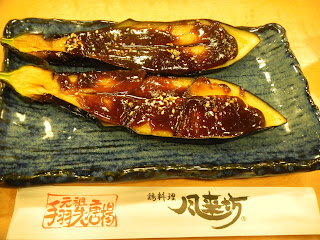
A simple but tasty grilled aubergine smothered in miso is a savoury delight. The firm texture of the Japanese eggplant lends to the grilling process leaving it crisp rather than limp.

The aftermath. A pile of bones reveal our shameful (but not regrettable) satisfaction.

Where Malaysians would gladly avoid a 4-person queue (for anything other than real estate perhaps), the Japanese patiently wait for hours in line for their favourite foods.

Having his meal before him, this metrosexual samurai has studied the traditional procedures involved in approaching Hitsumabushi, barbecued unagi (eel) rice or unadon. The main dish is divided into 4 quarters. The first quarter is ladled into a small rice bowl and eaten in this unadulterated form. The unagi is prepared by initial roasting then coated with sweet soya sauce, a speciality of the region, and grilled again.


The second serving, mixed with accompanying chopped spring onions, wasabi and shredded nori (sea weed) encourage the flavours to pop. The third quarter is ceremoniously drenched in dashi (ubiquitous Japanese kelp or fish stock) tea and slurped up till the bowl is clean.

The best is saved for last. The final serving is for you to savour in your favourite style. I love the Japanese mind for thinking this up. Sensual, philosophical and thoroughly human. If you're wondering whether equal amounts of unagi land up in each quarter, they thought that out too. To ensure this, unagi is cut into 1 cm pieces, rather than served as a whole in the usual unadon. Brilliant!


Kishimen is the local flat wheat noodle with a lot of bounce. With a choice of clear soup stock for the less adventurous,
to tangy vinegary cold noodles for hot summers,
to savoury miso gravy catering to the local romance with miso, it is a popular snack found in malls, stalls and festival areas.