The Portuguese founded the settlement of Macau in the mid 16th century. I was amazed that this east-west link of 500 years ago developed into such an intact and complete metropolis all that distance away from the motherland. Macau was truly the jewel of the Portuguese empire. In comparison, the Portuguese presence in Malacca is hardly visible, the inference being that it was a relatively insignificant port at that time.  The much photographed ruins of St Paul's Cathedral is the iconic monument of Portuguese legacy. However many more architectural gems in far better condition can be found around Senado Square, Rua Central and Avenida de Almeida Ribeiro, the historic centre of Macau.
  Senado Square has been the urban centre for centuries and remains the shopping hub of downtown Macau. Although the elegant neo-classical buildings now house the likes of MacDonald's and Starbucks, you feel transported to Lisboa forgeting you are actually somewhere in China.
 We were extremely lucky to chance upon a group of tourism students who were taking visitors on a walking tour of historic sites as part of their practicum for the tourism course run by the Macau Department of Tourism. An enthusiastic bunch, led by a Japanese teacher who used to be a travel writer, the students ran the entire show well, from commentaries in English and Mandarin, to caring for the road safety of the group, to providing illustrated brochures. The standard of spoken English was good.
  To my delight, around every corner was a photographic opportunity of heritage buildings. In 2005 Macau was put on the World Heritage list bringing the total in China to 31.
 The Macanese have the privilege of living in heritage buildings . . .
  . . . or the more typical apartment blocks along narrow streets.
 This traditional Chinese residential compound comprising several courtyard houses belonged to a prominent literary figure, and is being conserved for exhibition in the near future.
 St Augustine's Church, first established by the Spanish in 1591, is a popular site for the Easter procession. In the past, priests covered the roof with fan palms during the heavy rains causing the locals to name it, Temple of the Long- Whiskered Dragon.
  The Dom Pedro V Theatre built in 1860 was the first western-styled theatre with a seating capacity of 300. Today it hosts the annual Macau Music Festival held in spring.
  Bilingual signage is everywhere making it easy for visitors. Now what is wrong with that we Malaysians may ask?
 St Lawrence's Church built by the Jesuits in the mid 16th century is the oldest church in neo-classical and baroque style. Portuguese families would gather here to pray for the safe return of sailors and hence was called the Hall of Soothing Winds by the local Chinese.
  Local architects were influenced by the Art Deco style of the 1900's as well. This is now a boys' school near to St Joseph's Church and Seminary.
 The ambiance of the old city is nostalgically old Europe with a palpable Chinese presence.

 While old heritage is treasured, new traditions are imbibed readily.
 One of the first Portuguese residential areas was located in Lilau Square, where the ground water provided the main source of natural spring water. The old saying goes, " One who drinks the water from Lilau never forgets Macau".
 The Moorish Barracks built in 1874 accommodated the Indian regiment from Goa appointed to reinforce the police force.
  It was my father's standing comment to overseas visitors when we showed them Sultan Abdul Samad Building or The Secretariat - "British architects had a whale of a time in the colonies as they could experiment with designs from India to China, this being a fine example of Moorish architecture from India".
 So too in Macau. This now houses the Macau Maritime Administration.
 A-Ma Temple, a exemplary example of Chinese culture inspired by Confucianism, Taoism, Buddhism and folk beliefs, existed before the city of Macau came into being. Our walking tour ended here on Rua de S. Tiago da Barra. Our young guides helped us catch a bus and directed us to a local restaurant for Macanese food.
 The next morning, while the boys were playing their last game, I walked to Guia Fortress, a 45 minute walk from the hotel. The fortress was built in 1622. The lighthouse, built later in 1865, was the first modern lighthouse on the Chinese coast.
  A commanding view of the city from this vantage point was worth the long uphill walk.
 Guia Chapel, established by Clarist nuns, still preserves elaborate frescoes depicting western religious themes and Chinese mythical inspiration reflecting Macau's multiracial background.
 This lofty point is a popular photographic spot for newly weds.
 The park surrounding the fortress is the perfect peaceful setting for solo or group practice of Tai Chi


The much photographed ruins of St Paul's Cathedral is the iconic monument of Portuguese legacy. However many more architectural gems in far better condition can be found around Senado Square, Rua Central and Avenida de Almeida Ribeiro, the historic centre of Macau. Senado Square has been the urban centre for centuries and remains the shopping hub of downtown Macau. Although the elegant neo-classical buildings now house the likes of MacDonald's and Starbucks, you feel transported to Lisboa forgeting you are actually somewhere in China. We were extremely lucky to chance upon a group of tourism students who were taking visitors on a walking tour of historic sites as part of their practicum for the tourism course run by the Macau Department of Tourism. An enthusiastic bunch, led by a Japanese teacher who used to be a travel writer, the students ran the entire show well, from commentaries in English and Mandarin, to caring for the road safety of the group, to providing illustrated brochures. The standard of spoken English was good. To my delight, around every corner was a photographic opportunity of heritage buildings. In 2005 Macau was put on the World Heritage list bringing the total in China to 31. The Macanese have the privilege of living in heritage buildings . . . . . . or the more typical apartment blocks along narrow streets.This traditional Chinese residential compound comprising several courtyard houses belonged to a prominent literary figure, and is being conserved for exhibition in the near future.St Augustine's Church, first established by the Spanish in 1591, is a popular site for the Easter procession. In the past, priests covered the roof with fan palms during the heavy rains causing the locals to name it, Temple of the Long- Whiskered Dragon. The Dom Pedro V Theatre built in 1860 was the first western-styled theatre with a seating capacity of 300. Today it hosts the annual Macau Music Festival held in spring. Bilingual signage is everywhere making it easy for visitors. Now what is wrong with that we Malaysians may ask?St Lawrence's Church built by the Jesuits in the mid 16th century is the oldest church in neo-classical and baroque style. Portuguese families would gather here to pray for the safe return of sailors and hence was called the Hall of Soothing Winds by the local Chinese. Local architects were influenced by the Art Deco style of the 1900's as well. This is now a boys' school near to St Joseph's Church and Seminary.The ambiance of the old city is nostalgically old Europe with a palpable Chinese presence.While old heritage is treasured, new traditions are imbibed readily.One of the first Portuguese residential areas was located in Lilau Square, where the ground water provided the main source of natural spring water. The old saying goes, " One who drinks the water from Lilau never forgets Macau".The Moorish Barracks built in 1874 accommodated the Indian regiment from Goa appointed to reinforce the police force. It was my father's standing comment to overseas visitors when we showed them Sultan Abdul Samad Building or The Secretariat - "British architects had a whale of a time in the colonies as they could experiment with designs from India to China, this being a fine example of Moorish architecture from India".So too in Macau. This now houses the Macau Maritime Administration.A-Ma Temple, a exemplary example of Chinese culture inspired by Confucianism, Taoism, Buddhism and folk beliefs, existed before the city of Macau came into being. Our walking tour ended here on Rua de S. Tiago da Barra. Our young guides helped us catch a bus and directed us to a local restaurant for Macanese food.The next morning, while the boys were playing their last game, I walked to Guia Fortress, a 45 minute walk from the hotel. The fortress was built in 1622. The lighthouse, built later in 1865, was the first modern lighthouse on the Chinese coast. A commanding view of the city from this vantage point was worth the long uphill walk.Guia Chapel, established by Clarist nuns, still preserves elaborate frescoes depicting western religious themes and Chinese mythical inspiration reflecting Macau's multiracial background. This lofty point is a popular photographic spot for newly weds.The park surrounding the fortress is the perfect peaceful setting for solo or group practice of Tai Chi
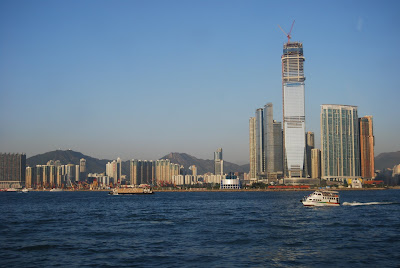

 After what seemed to be an endless 27-hole walking course of water hazards, ferry ramps and escalators, without golf trolleys or caddies, we finally reached our destination.




 Shops stretch from North to South, East to West along canals ala Venice. With a painted blue sky and fluffy white clouds you can shop in perpetual bliss and may even take a gondola ride to complete the fantasy.
 I had done some research before the trip and found out that ZAIA is a resident show by Cirque du Soleil presented exclusively at