Wednesday, 1 April 2009

Yanaka - a Bit of Old Tokyo

Armed with brochures and directions from the helpful English-speaking guides at the Tourist Information Center in Tokyo Metropolitan Government Building directly connected to the Tochomae subway station, I decided to leave the sky scraper district and head for quaint old Tokyo. Yanaka district, in north-east of Tokyo, was a developed as a temple town in the Edo period (1603-1867). And yes, the cherry blossoms are finally out in some areas. The south of Japan starts blooming first and then the wave moves northwards.Prominent temples like the Tenouji and the Kaneiji were founded here. One of the main streets is lined by temples. . . a photographer's paradise.
You see what I mean?
The Yanaka Cemetery, site of the grave of the last shogun Tokugawa Yoshinobu, is next to the Nippori subway station which provides the nearest access.
This traditional downtown neighbourhood of narrow streets and small traditional wooden buildings and homes exudes a forgotten cosiness and warmth and is reflected in the charming and friendly people of the area.
Miraculously the Great Kanto Earthquake in 1923 and the Great Tokyo Air Raids of 1945 left Yanaka unscathed for the benefit of us all. Thank goodness!

It is easy to slip back to the quiet days of kimonos and bicycles. The mode of transport is still there but its jeans and T's now.

From duplex mansions . . .

. . . to shanty bamboo panelled homes . . . it's all real.

The Buddhist places of worship are called temples and usually have graveyards in them. In Shinto, the worship of ancestors and national heroes, the mon or gate at the entrance to the shrine is characterised by bright orange wooden pillars and cross bar, instantly recognisable as Japanese.

The avenues of sakura are gentle to the eye and instantly transports one to a happy safe place. The Hanami (sakura picnic) is casually spent here by the side of temples and grave stones. The Japanese are known to be both Buddhist and Shinto and embrace life with an openness that is rare.

Yakana Ginza is the local shopping street full of character and ethnic shops. The local biscuit shop.Calligraphy anyone?

No Starbucks outlets in this neck of the woods . . .
just good UCC (Ueshima Coffee Company) all-Japanese coffee here.
The steam bath is a social gathering point found in each district throughout Japan. The recognisable chimney is the give away.
As twilight emerges . . .
. . . traffic disappears home . . .
. . . and lights emerge and blend with nocturnal activities of
swish bistros, wine bars . . .

. . . and the local pub.

The best for last, my philosophy, that is, a warm dinner, ambiance, and background recordings of Miles Davis playing in Blue Note. I picked this Okinawan restaurant for those reasons. Don't you love that thick wood bar table top?
Albeit a lonely meal of Deep fried Camembert with raspberry dip, Goya (bitter gourd) with egg and bean sprouts and a green tea sour, it was still perfect for savouring the day. . .

Monday, 30 March 2009

Shinjuku, Shinjuku

In the heart of Shinjuku lies Lumine Est, a shopping mall adjacent to the JR Station and Metro. Floors 7 & 8 were a gastronomical discovery and the answer to the next few meals I'm sure.
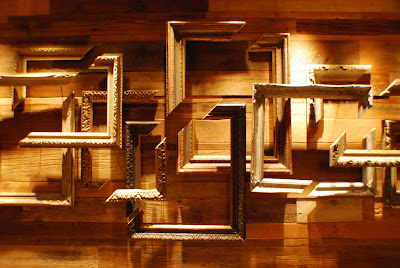
Japan is big on recycling, which is a good thing, and the decor reflects this well. Old frames plus lighting ... and voila you have a great feature wall. The famous have an outlet here as well as at every major area in the city. The row of chairs are in anticipation of the queques at meal time. Unique to Japan, all restaurants worth their salt set out chairs or even benches to encourage customers to wait for a table. Okinawa cuisine is popular and famous for its goya dishes cooked as tempura, or sweetened by soaking in brown sugar. Goya is a gourd with a characteristic bitter taste and considered a refreshing summer dish. Goya is rich in Vitamin C and has been used medicinally in China, India and Arabia for centuries.
An interesting wall of corrugated cardboard painted red. The Japanese take pains in recycling their garbage. The sorting and recycling starts at home and carries on into public places like the parks. Special days are allocated for disposal of inflammables, paper or plastic. Bottles and cans are disposed of in designated collection areas. I just found out today that pieces of paper smaller than a post card are deemed non-recycle worthy. The Paper Museum gives a detailed history of the use of paper in Japan through the centuries as well as the modern challenges of recycling. Of course sushi and sashimi is everywhere . . . presentation being just as important as freshness.Wondered where all the old PC's, CPU's and keyboards went to? In this case a wall. It makes a statement, a reminder of mans excesses polluting the planet.
The famous plastic food of Japan. It certainly helps when you don't know the language. The point and smile method works all the time.When stacked up pipes and meter boxes are painted grey they make stark contrast with large glass sheets . . . most effective decor effect. A tastefully decorated lounge area amidst the restaurants lends a spacious feel. This new interior design concept certainly adds to the trendy ambiance.The romance with all things American still lingers on here in the Land of the Rising Sun. The hamburger is given a Japanese twist with teriyaki flavouring; rice, noodles or fries as accompaniments, shredded cabbage with mayo and grilled onion rings. For desert you have the choice of French pastries, crepes (penchant for all things French as well), waffles or this new wave ice cream - Cold Stone. Creamy flavours of your choice are mixed and folded on a freezing stone surface before your eyes. To add to the fun, the cheerful young girls behind the counter break into little ditties of song as part of the performance. Ice cream served till 11 pm...who could ask for more?
Rushing off to catch the last train (midnight for JR line; 1 am for the metro) is this rare sight of two genteel Japanese ladies dressed in kimono. Special Sunday occasions and weddings are about the only time the kimono is donned these days. The cultural divide widens as modern wins over traditional.

Saturday, 28 March 2009

I love Tokyo in the Springtime


What I love about Tokyo and Japan is its predictability, discipline and above all the respect afforded to their fellow man.

The Airport Limousine bus counter is strategically situated directly in front of the arrival hall exit and the bus stop is clearly marked (in English) just as you step out of the terminal. When you buy your ticket you are informed of the time of the next bus, unlike in some places where you have to pry the information with difficulty.

At the stop, the bus attendants follow a strict SOP (standard operating procedure). They give respectful acknowledgement by bowing to bus driver as he draws up to the stop; tag the luggage giving you the stub, collect your ticket, load the luggage and again bow to the driver as he moves off. Its a simple procedure , but done with finesse.

A recorded announcement in the bus welcomes visitors and advises the use of safety belts. The female Japanese voice with a somewhat stilted English accent reminds that mobile phones are not to be used on the bus 'as it will disturb the neighbours'. However foreigners have been known to ignore this practice.

It was a cold, wet and windy 7 degrees Centigrade on landing at 1900 hrs. The next morning was no better, but the sun did peep through the clouds at noon.Just in time too for the Hanami party to celebrate the Sakura season. The only problem was that the sakura were still a bit shy in blooming due to the weather.The green mats are spread and each person brings some food or drink. This was a cosmopolitan group of students of a Japanese language school. Germany, Switzerland, France, Australia, Canada, USA and Malaysia were represented.
All sharing experiences in Tokyo, all in Tokyo for various reasons and all absorbing the cultural with Japanese friends.

Now all that is required is that the cherry blossom start blooming . . . please!

Jazz on high

For the ultimate Jazz experience and a night view of Bangkok head for the Dome, Lebua at State Tower on th banks of the Chao Praya River.With the view of the river, city and wind blowing through your hair, you wouldn't want to be anywhere else.Add to that a full moon and the band playing Cole Porter favourites you really succumb to the night.Let the strains of Misty, Unforgettable and I've Got You Under My Skin send shivers down your back because you don't want this nigfht to end . . . But you know that it will, and you come back for more . . .


Friday, 20 March 2009

The Kingdom of Ayutthaya

A must-do in Bangkok is the tour of Ayutthaya, going by bus and returning by a cruise down the Chao Praya River. For 1800 Baht (USD 50) this whole day trip is a steal with lunch, pick-up and drop-off at hotel arranged.
This should be followed up by the Siam Niramit show at the Thailand Cultural Center which promises to bring to life the history and culture of the people of Thailand in vivid colour. It simply completes the experience.

After having visited the ruins of Ayutthaya about 8 years ago with my late father, he would have been happy to know that the ancient site is looking better than before due to ongoing rehabilitation and excavation of this World Cultural Heritage site. The Ayutthaya estate, situated on an island, lends to its strategic position and rich rice economy.

The Kingdom of Ayutthaya and then capital of Thailand was established in 1350 AD by King Ramathibodi and lasted for 417 years. Wat Chaiwatthanaram, one of the most important Bhuddhist monastries consists of a main prang (Khmer-type tower) and 4 lesser prangs surrounded by a further 8 lesser prangs, occupies pride of place centrally.

Most of the Buddha images have been looted except for this one trapped in the roots of a fig tree. Headless figures line the Wat as testament to mans' greed and penchant for destruction. The few remaining images of Buddha can be viewed at the Chao Sam Praya National Museum.Back in the day, Ayutthaya was a busy metropolis and welcomed foreign traders, including the Chinese, Vietnamese, Indians, Japanese and Persians and later the Portugese, Spanish, Dutch and French permitting them to set up villages outside the city walls. The strong Chinese influence is seen throughout the city to this day.

In the sixteenth century, it was described by foreign traders as one of the biggest and wealthiest cities in the East. The pomp and pageantry is well depicted in the Journey back to History at Siam Niramit.

The court of King Narai (1656-1688) had strong links with that of King Louis XIV of France, whose ambassadors compared the city in size and wealth to Paris.


So strong was the French influence on the Thai royalty that the Bang Pa In Summer Palace dating back to the 17th century was built in French architectural style. King Mongkut (Rama IV) revived this style in the 19th century and the result is what you see today.

A Chinese style residence built in China was transported over as a gift to King Chulalongkorn (Rama V) by the Chinese Chamber of Commerce in 1889.

The might of Ayutthaya knew no bounds and its vassals included the Northern Shan states of present-day Myanmar, Lanna (Chiang Mai, Yunnan & Shan Sri (China), Lan Xang (Laos), Cambodian Kingdom, and some city-states in the Malay Peninsula. Early on in his reign, King Ramathibodi had seized Angkor from the Khmers.

Malacca and other Malay states had become Muslim early in the 15th century, and thereafter Islam served as a symbol of Malay solidarity against the Thais. As it failed to make a vassal state of Malacca, Ayutthayan control of the strait was gradually displaced by the Malays and Chinese.

In 1569 Ayutthaya eventually fell to the Burmese Kingdom of Tounggoo as part of its 'imperial expansion' plan.


Imagine this apsara / nymph / celestial maiden stepping out of the alcove . . . magical effect in Siam Niramit.

Ayutthaya entered into its golden age, a relatively peaceful episode, in the second quarter of the eighteenth century when art, literature, and learning flourished while foreign wars were fought against the Vietnamese and Burmese. Eventually Ayutthaya fell in 1767 to Burma after a lengthy siege. Ayutthaya's art treasures, the libraries containing its literature, and the archives housing its historic records were almost totally destroyed.

Leaving behind the legacy of ancient Ayutthaya, the 2-hour river cruise afforded time to savour Bangkok au natural along the Chao Praya.

A Wat in downtown Bangkok.
Rama VIII Bridge
Riverine Temple

The 'Bangkok Hilton'

Luxury villa

Bangkok skyline