Showing posts with label Indonesian lifestyle. Show all posts

Saturday, 27 June 2009

Bali Dreams II

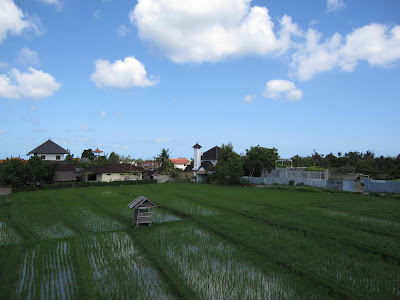
Breaking from the holiday mode, the intrepid travellers, now joined by another adventurous pair, the only difference being they are still in the child-raring phase, decided to check out the Bali real estate market - villa viewing! Encouraged by the drastic drop in real estate everywhere, this fact had to be verified by this team. Imagine waking up every morning to this organic view beside padi fields in a quiet part of Bali. . . . and this facing you in your king-sized four poster bed in the en suite master bedroom.

Escape Villa complex surrounded by padi fields and blue skies.

A last longing look at the environs of this dream villa.
The next few properties had something missing; either great bedroom views but bad structural design or bad views and even worse construction quality. Even with a soft property market the prices were not inviting.
Moving on, we are told that this house belongs to an 80's pop star who is in the red! The house is rustic with a lived-in feel sitting on a generous-sized land area . . .
. . . surrounded by padi fields. What is most impressive is the high level of maintenance that is evident in the better villas. Luscious well-groomed garden, Balinese veranda and open-air bathroom.

Just Googling 'Bali villas for sale' you get 13,800,000 hits and our agent, Ian (resident in Bali since 1997) from the UK tells us that there are 64 real estate agents in Bali fighting over the same turf.

Finally the creme de la creme of super villas - Layar, or so goes the marketing blurb. The interior design of clean lines and woody finish are contemporary and impeccable in taste. The variety of outdoor bathrooms have been a feast for the eyes - all Conde Nast stuff.

The journey ends with thoughts of a second visit to view more villas in the near future. Major issues to consider in buying property in Bali or anywhere in Indonesia is that the property would have to be bought under the name of an Indonesian nominee (whatever that means?). The agents flick this off when questioned as 'its normal', 'done all the time by expat buyers' and the 'lawyers know what to do'. The later statement itself is enough for the more discerning Asian buyer to view this some amount of apprehension.

All said and done, the fun was in the chase . . .

Thursday, 25 June 2009

Bali Dreams I

The visit to Bali for a couple of birthdays turned out to be a trip with a difference. The long trek up to Tembok, on the northern coast of the island took more than five hours through scenic villages, terraced padi fields and local culture. The roads were surprisingly roadworthy and although narrow, traffic flowed smoothly enough. I compared this to our drive to Agra from Delhi in a jaunty white Ambassador four-seater, where being stuck behind a bullock cart pregnant with dried grass was a test of patience for the passengers more than the driver.
Tembok was like a diamond in the rough. The peaceful ambiance was a trademark of YLT resorts. Peaceful being the operative word - no children, no TV and no computers. An IPod docket is provided in the rooms for the trendy. Perfect for honeymooners, of which there several pairs from India, Europe and China, the new profile of today's travellers who seek a different experience. Beach-front cabana's draped in white linen would be the perfect setting for an intimate cuddle for lovers. The spiritual merges with the physical and then becomes one with nature on black sanded beaches - idyllic personified. Dusk brings on a different mood . . . the golden glow spreading from the skies on to the sand and pebbles in one fluid sweep, like an artist executing a water-colour wash. . . . one merging into the other. . . hand in glove. As if by magic the 'kechak' monkeys make their appearance, and beckon the spirits to be kind to lovers and protect them from ogres and demons.
While the night is still young, a gentle man, is already in slumber mode oblivious of cosy cabanas or starry skies. The return journey, through the central spine of the island, led us to an imposing view of an active volcano, Mount Batur.
Back to urban culture, the local flavour melts into international pop themes . . . But it is all good, and all things are relative - so it is said . . .

Thursday, 12 March 2009

Rags to Riches - the Sampoerna 'Kretek' Story

The story of Liem Seeng Tee, a young boy orphaned soon after arriving with his family from Fujian, China in 1898, is one of perseverance against all odds and vision. The founder of Sampoerna, one of the leading clove 'kretek' cigarette company's in Indonesia, started off with a humble roadside stall in Surabaya, selling home-baked cakes and hand-rolled clove cigarettes.

His special Blend 234 soon gained popularity and with the savings set aside by his thrifty wife, Tjiang Nio, he acquired a large quantity of tobacco blends. Chocolate, vanilla, nutmeg, cinnamon and cloves were added to the tobacco blend to create kretek, named after the crackling sound of burning cloves. While sounding and smelling exotic, the ashes of the burning cloves tend to burn little holes in your clothes, so be warned!

It has been documented that Haji Jamahri, from Kudus, Java, created kretek in the early 1880s as a means to deliver the medicinal eugenol of cloves to the lungs, as it was thought to help sufferers of asthma. This is not substantiated medically. Eugenol actually causes numbness of the throat which in turn can diminish the gag reflex and lead to aspiration of gastric contents. 90% of smokers in Indonesia smoke kretek.

Reference: (December 1988). "Evaluation of the health hazard of clove cigarettes. Council on Scientific Affairs". Journal of the American Medical Association 260 (24): 3641–36444.


The family business grew substantially but suffered a setback during World War II when Liem was interned. He restarted the business after his release. During the struggle for independence, the business floundered again, but recovered under the helm of his sons Aga and Putera.

In 1932 Liem Seeng Tee purchased the stately Dutch colonial-style orphanage and compound circa 1858, now deemed a heritage site.

The stained glass panels are a prominent feature of this building.In commemoration of Sampoerna's 90th anniversary in 2003, the central complex has been painstakingly restored and is now open to public. A guided tour on request is most illumunating.

Family and business memorabilia fill the halls. The company involved itself in all aspects of the product, from printing packets and labels, . . . . . .acquiring tobacco blends from all over the world, . . .. . . to collecting paintings and photographs with a cigarette theme.

The art work, especially the black and white photographs reflected the mood of the times.
In 1991, as a promotional exercise, the company sent a team to participate in the Marching Band Competition at the Rose Parade in Pasadena, California. The Sampoerna Marching Band won first place.The trophy, instruments, Sampoerna Marching Band practice sheets and manoeuvres and even airplane tickets are displayed with pride.The art decor lamp on the bannister sets the ambiance for the creative stain-glass window featuring Sampoerna blends on the landing.

Today, the compound is still functioning as a production plant for the famous Dji Sam Soe blend. The factory floor, almost as it was in 1932, where women workers hand-rolled the kretek, is impressive.

The Sampoerna Foundation gives back to the citizens of Indonesia as part of its Corporate Social Responsibility by way of supporting education. More than 32,000 scholarships have been given to deserving students. In 2009, the Foundation enhanced its commitment by setting up a Teacher Institute and an international standard boarding-school program called the Sampoerna Academy.

An art gallery, housed in an annex building, holds regular exhibitions of local artists.

At the time of our visit the delicate 'Ink on Paper' by artist Jansen Jasien was on display.

The piece de resistance after an absorbing tour is to walk into this delightful art decor Cafe to quench the thirst on teh halia (ginger tea) and gado gado (Indonesian salad with peanut sauce). Yum!

I would be remiss in my responsibility if I did not give a Pathologists warning: Djarum Black cigarettes produced for consumption in Indonesia contain a significantly higher quantity of tar and nicotine, 25mg and 1.6mg respectively.

A quick check on tar and nicotine content of cigarettes yielded this website http://www.erowid.org/general/about/about_faq.shtml belonging to Erowid.org, which is an online library of information about psychoactive plants, chemicals, and related topics. It lists the highest and lowest tar and nicotine content of cigarette brands in the US of A, the highest for tar and nicotine being 27mg and 1.7mg respectively. The only difference is the clove content.

A model sail-boat made of cloves.

The 'riches' part of the story finally ends with Philip Morris International acquiring a 40% stake in Sampoerna from a number of its principal shareholders on 14 March 2005. The moral of this story is persist, persist, persist.....and save, save, save . . . which is a good example to follow in these troubled times.