Showing posts with label Japanese lifestyle. Show all posts

Wednesday, 13 April 2011

Ganbatte Japan

Ganbatte - in simple terms means good luck, do your best, but to the Japanese the deeper implication is to exhaust yourself, persevere, keep fighting (with nuances of strong encouragement and respect for efforts made).
So despite the tragedy they celebrate spring and the beauty of Sakura blossoms, a sign of new beginnings.


The street dancers of Nakano still hang out and practice outside the Municipal buildings' reflective glass walls.


The local library still remains the refuge for the vast retired population. The sense of community living is well entrenched.


Meanwhile aftershocks are a continuous daily occurrence, several times a day. While shopping in Isetan Shinjuku, a rather large aftershock sent shop assistants selflessly herding shoppers to designated safe areas, corridors away from display glass shelves and we were asked to assume the crouch position. A hard hat would have afforded extra reassurance, but can you imagine going shopping armed with your umbrella, jacket and helmet!


We all take chances don't we? Tap water has been deemed safe for infants, but most are still buying mineral water which is now limited to 4 bottles per person. When you eat in a restaurant the water served is tap, so at some point there has to be trust.
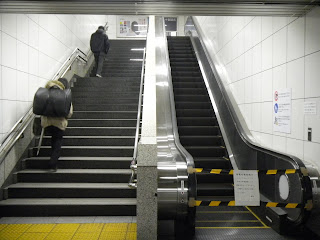

Electricity cuts are real and clearly evident. Most escalators in train stations are switched off except for the deeper lines like Oedo Line. Elevators still work. Good workout for quads, hamstrings and glutes I say.

Alternate street lights are meticulously
switched off. Unnecessary lighting in shops and public ares are minimised.


I felt that the wait between trains was longer than usual. Train schedules have been revised.

But I must congratulate the service. They were up and running at 90% less than 24 hours after the earthquake. I know because my son managed to get home the next morning, albeit via a less direct route.


The human spirit is strong.
It has to be for the sake of the children. . .


. . . and love.

Thursday, 7 May 2009

Tokyo walkabout

I owe thanks to these wonderful shoes - Merrell Gore-Tex - for my trekking through the hard streets of Japan. Nothing like a pair of good shoes. They even look good. Am in good company, it seems this early summer, with the three-quarter roll up look. Footwear in Tokyo is fun to watch. Metro fashion can keep you occupied for as long as 10 stations. Believe me the guys often outdo the girls in this regard.

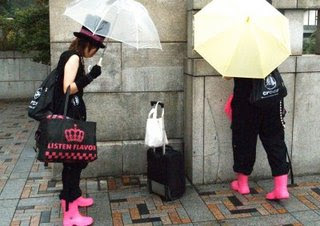
I am completely taken by the construction workers outfit. From the baggy pants, avante garde unintentional paint design to the toe-socks and slippers, it is a fashion statement of a different kind. Spring showers are not a deterrent to fashion either. The best looking galoshes can be found in Tokyo.

Not forgetting Harajuku fashion...and the Lolitas...
Then there's the ninja look... which morphed to this...

and then to this... How cool is that!

The traditional partnering the modern...

And now for some leg. The over-the-knee-stockings are the current rage.

Great with mini skirts and shorts...perfect summer wear.
Don't knock it 'cos even the anime world is sporting the look.


Gyaru is a Japanese transliteration of the English word gal.

The fad began in the 70's, as all earth-shaking things did, and has evolved to the 2000 millennium version of ganguro fashion, a deep tan combined with hair dyed in shades of orange to blonde, or a silver gray known as "high bleached". Black ink is used as eyeliner and white concealer is used as lipstick and eyeshadow. False eyelashes, plastic facial gems, and pearl powder are often added to this. Platform shoes and brightly-colored outfits complete the ganguro look. Visuals from this site complete the imagery.
http://teamsugar.com/group/1053666/blog/1071530


You needn't bother with these, as they do not have any punch in this neck of the woods!


If you've lost a sock in the wash, this is one city where it don't matter...just whip out a contrasting partner and it will be fine, kawaii, no less!

Sunday, 26 April 2009

Inside the Japanese mind...

Hanami, the traditional party-in-the-park to celebrate the arrival of spring and cherry blossoms epitomises the Japanese love of life and nature. Throngs head for their favourite parks, and settle down on blue tarps and share pot-luck goodies and sake. Friends, families, clubs and - more creative still - a mommy-and-baby group get together.Office colleagues utilise this time to chill out and improve bonds in this hierarchical environment. The junior-most salary men (typical Japanese office workers) have the honour of organising the nitty gritty, most important of all staking out the party space. Others may have to sleep on it . . .After work at 7-8 pm the big guns stroll in and the party is on. Ueno Park allows alcohol to be brought in, however Shinjuku Gyoen Park does not and charges an entrance fee of 200 yen. You have to give it to the Japanese for detailed organisation and being prepared. Garbage bins sorted by category for cans, plastic and biodegradables are put in place for the occasion. At the end of the day you can be sure the park is spotless!
Harajuku is paradise for the kinky, especially on Sunday, where the Goths and Lolitas go on parade. This is where the kawaii/cuteness culture explodes. It emerged in the 70's as a new style of writing, invented by teenage Japanese girls, where pictures of smiley faces, stars, hearts, etc. were randomly inserted between text. This was considered cute. You could say this was the first use of emoticons that we love so much. In the 80's, cute icons like Hello Kitty and later, Pikachu from Pokemon emerged and set the mold for things to come. Sociologists report that 'cute' is now considered a 'magic term' that encompasses everything that's acceptable and desirable in Japan.Japanese kids 'just wanna have fun'. Very much into fashion and boy bands/Johnnies, they roam the streets of Shibuya, where the famed multicrossing exists, until the last train at midnight. The worst swear word is the 4-letter word starting with 's' for excrement. F U or any equivalent does not exist as sex is not considered dirty or worth cursing about!
Somewhere in Kyoto a group of ladies are also dressed to the nines in traditional kimonos, a practice that seems to be gaining popularity. Meanwhile, three maiko or geisha-in-training, in full regalia and white makeup, hurry along the streets of Gion to meet their patrons. Geisha or female Japanese entertainer is a profession still embraced to this day although its population is diminshing. High school or college leavers undergo training of not less than six months to learn traditional instruments, dances and songs befitting an entertainer. They are hired to attend parties, dinners and tea ceremonies. In the Japanese context, the geisha's role ends at playful innuendos. It is the Western presumption that more than this is rendered.

Love hotels exist out of sheer necessity due to the close living quarters and appreciation for privacy. In a country where sex is accepted without much of the guilt associated with it as in the West, a couple can rent a room for a few hours and be assured of anonymity. All transactions are done by video menu and vending machine. Love hotels cater to all tastes and desires from wild west rooms to private swimming pools to other less conventional preferences. There has been a shift in focus where the decor now caters for women's themes. Even single women utilise this facility for some luxury, privacy and space. For a particular comic writer whose illustrations revolve around the love hotel, these establishments are an extension of her office, so to speak. Riding the trains is where you can elbow in with everyday people. The Japanese have perfected the art of napping either sitting down or standing up as well as getting off at their stop. An urban legend tells of a salary man who has taken the train to work for the past 40 years and has only missed his stop 4 times - believe it or not? What used to be a reading society of standard-sized paperbacks and manga, has seen an obvious swing to MP3s, iPods and electronic devices, especially since the launch last year of Playstation Portable (PSP) and Nintendo DS.

It is difficult to not to get up close and personal on the JR lines. Eavesdropping becomes a neccessary evil.
Make of this what you will...

Gal: Stop making noise! (In a rough manly/aggressive tone)
Guy: I'm not. (In a meek voice)
Gal: You are!! (Getting more aggressive)
Guy: No I'm not... (kawaii)
Gal: Yes you are... with your eyes!!

... Is this a Love Hotel moment?


Sunday, 19 April 2009

Baring it all at the Onsen

In Japanese philosophy, Onsen, Japanese hot spring bath, is the diametric opposite of everything in normal, hectic day-to-day life. Onsen blends the mysticism and spirituality of the East into the traditional sweat bath practice, lending it a Zen, meditative quality. This has been practised for thousands of years and is a major part of Japanese culture and lifestyle, providing a socially acceptable relief from the pressures of the contemporary Japanese twelve-hour work ethic. It represents an opportunity for the Japanese to melt down the hierarchical nature of society through mutual nakedness and intimacy. Hot springs are distinguished by the minerals dissolved in the water. Different minerals provide different health benefits, and all hot springs are supposed to have a relaxing effect on the body and mind. Hot spring baths come in many varieties, indoor and outdoor, gender separated and mixed. For most Japanese Onsen is not a regular part of life, but essentially a respite from it and is enjoyed throughout the seasons.Hill retreats like Hakone are famed for their ryokans (tradition Japanese rest houses) and onsen where residential facilities include 3 meals and a tatami-styled room where one sleeps on futons spread out on the floor. Kusatsu hot spring is widely recognised as one of the best quality spring waters rich in sulfur, aluminum, sulfate and chloride of high acidity. A traditional folk song sings the praises of the therapeutic benefits of its spring water that it is able to “cure everything but love sickness”.Tradition has been successfully commercialised in the major cities where theme park onsens thrive on the energy of the young and tourists. Its a matter of taste - modern design . . . . . . versus rocks and boulders.Additional attractions like Doctor Fish spas have been introduced to titillate the senses. Garra Rufa, a type of small tropical fish, are able to withstand temperatures of up to 43-degree hot waters. They eat dead skin (no they are not piranha) and are used for the treatment of skin diseases. Another intriguing spa therapy is the sand bath, originating from Ibusuki, Japan. Wearing a yukata (Japanese cotton robe) one is buried up to the neck in heated sand for 15 minutes to achieve the benefits of this detox treatment. Together with improved circulation, one feels surprisingly refreshed after a sand bath. Now comes the hot topic of etiquette. The onsen is not a place to cleanse oneself but rather to relax and benefit from its therapeutic effects. One is required to disrobe and don a yukata. In the bathing area, one must be prepared to bare all, and head for the washing station for a good scrub and wash. Good quality bath and hair shampoo and conditioner are provided. All you have is a small stool to hide your modesty which is a better option than standing upright in full view, belting out strains of "Obladi oblada..." as you would do in your own shower! Rest assured there will be a major uproar if there is nonconformance of this practice. Embarrassment is a given and not just because one is caught with one's pants down!
Armed only with a wash cloth, a meager 15 cm x 40 cm, which you are not supposed to immerse in the water but keep on your head, you wander to pools of varying temperatures and mineral content and gracefully immerse yourself without screaming as you embrace the hot water.

Very soon you do relax and enjoy the moment despite the obvious nudity all around you. For those of us who are not used to this practice, it is better to go to an onsen on your own, I think. You cut out the giggles and stress. After 30 minutes you imagine yourself on a different planet, feeling as light as a feather and drifting from pool to pool without a care. Perhaps this is what it must be like on the island of Lesbos or before Adam and Eve ate that wretched apple! Pure bliss.