Wednesday, 18 March 2009

Bangkok Dangerous . . . to not so dangerous.


Walking down Soi Cowboy, located close to the intersection of Sukhumvit Road and Asoke Road, brought to mind the 2008 Nicholas Cage movie Bangkok Dangerous. Beware of tuk-tuk drivers offering to take you to sights you have never seen before! The colour red blanketed the street filled with curious men, mainly Caucasians, on a look-see and the local women on-the-prowl all set to tangle. From women-in-black to short short denim shorts, it is obvious that the demand fuels the trade - which is a gainful option to feed a family in poverty back home in the provinces. Watch the moves of the guy in the doorway..... . . . as he gets reeled in!
If other desires need addressing, good eats abound like fried grasshoppers or caterpillars to up your protein intake,. . .. . . a foot massage as you enjoy succulent fresh pineapple and papaya, . . .
. . . retail therapy . . .
. . . or even giving in to the sensuous guiles of the girlie-barber for a haircut, shave and a bit of pampering. To digress a little, a former Thai cabinet minister, initiated a family planning and safe-sex program by promoting the use of condoms, after a visit to provincial areas and noticed the enormous number of children in the villages where the population growth rate was 3.2 percent with an average of seven children per family.
Mechai with condom teddy bear

Mechai Viravaidya, a 67 year old cherubic gentleman of Thai and Scottish parentage, founded his now-famed nongovernmental organization, the Population and Community Development Association (PDA) in 1974 to promote community-based family planning service operating throughout the towns and villages of Thailand. Almost 20 years later, the population growth rate has come down to a 1.2 percent average, or two children per family. It is Mechai Viravaidya who has been credited with Thailand's population being 20 million less than it would have been. His success earned him the undisputed title of the Condom King of Thailand. He is so well-known in Thailand that in rural areas, Thai slang for condom is "mechai."
His premise was simply that "Too Many Children make You Poor", making this the campaign song popularised among the youth. "We use our condom campaign as a means of desensitizing the issue. We make people laugh, we make people able to talk about family planning and not feel embarrassed about it."
He started a restaurant named Cabbages and Condoms (C & C) in Soi 12, Sukhumvit Road well known for its excellent Thai cuisine and eye-catching decor and campaign souvenirs. "Cabbages are very common in Thailand," Mechai explains, "and I wanted to make condoms as common in this country as cabbages."

The C & C tag line . . .

The secret of PDA's success lies in the unconventional approach in playing on the Thai sense of humor. For example, "vasectomy festivals" were held in honor of the King's birthday; . . .

. . . a "cops and rubbers" project where the entire police force distributed condoms to the public; and Captain Condom & "condom nights and festivals" in the red light districts where condoms and safety-tip cards are handed out to commercial sex workers.

Mechai with Captain Condom

"Condom nights" Ops

In 2007, the PDA received US 1 million dollars from the Bill and Melinda Gates Foundation together with the Gates Award for Global Health for his achievements in family planning and AIDS prevention.

Condom dresses at an AIDS conference.

In May 2008, PDA signed a MOU with Ngee Ann Polytechnic, Singapore to send students from the School of Humanities to Thailand as part of their internship. The plan is to expose students to initiatives to help reduce poverty and foster community spirit in Thailand. True to his quirky sense of humour on safe-sex he distributed T-shirts 'Stop global warming, use a condom' to the students, the same that he gave to former US Vice President Al Gore.

Moving away from the sleaze and risque was a breath of fresh air. For a totally different scene, step into Soi 3 and discover the Arab Quarter of Bangkok.
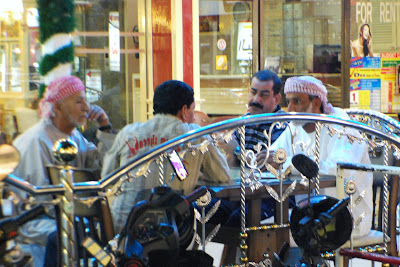
The aroma of cloves, cardamoms and roast lamb hit you in the face and cling to your clothes. The stainless steel decor, the prefered taste, adds to the glitz. One of the restaurants clears its premises for the congregational Friday prayers as part of a community service.

As if out of a page from a tourist brochure of Dubai, a minyak atar shop or perfumery stands on the next corner. The comfort zone is created with all things familiar.Mandhi rice served with lamb or chicken is available here, of course. The Thai influence is telling when the accompanying condiments is a green chili salsa instead of the usual tomato-based puree.

The Arab tourist sector in S E Asia is growing steadily with the establishment of these ethnic quarters, as they move away from destinations like the US, UK and Europe.

Thursday, 12 March 2009

Rags to Riches - the Sampoerna 'Kretek' Story

The story of Liem Seeng Tee, a young boy orphaned soon after arriving with his family from Fujian, China in 1898, is one of perseverance against all odds and vision. The founder of Sampoerna, one of the leading clove 'kretek' cigarette company's in Indonesia, started off with a humble roadside stall in Surabaya, selling home-baked cakes and hand-rolled clove cigarettes.

His special Blend 234 soon gained popularity and with the savings set aside by his thrifty wife, Tjiang Nio, he acquired a large quantity of tobacco blends. Chocolate, vanilla, nutmeg, cinnamon and cloves were added to the tobacco blend to create kretek, named after the crackling sound of burning cloves. While sounding and smelling exotic, the ashes of the burning cloves tend to burn little holes in your clothes, so be warned!

It has been documented that Haji Jamahri, from Kudus, Java, created kretek in the early 1880s as a means to deliver the medicinal eugenol of cloves to the lungs, as it was thought to help sufferers of asthma. This is not substantiated medically. Eugenol actually causes numbness of the throat which in turn can diminish the gag reflex and lead to aspiration of gastric contents. 90% of smokers in Indonesia smoke kretek.

Reference: (December 1988). "Evaluation of the health hazard of clove cigarettes. Council on Scientific Affairs". Journal of the American Medical Association 260 (24): 3641–36444.


The family business grew substantially but suffered a setback during World War II when Liem was interned. He restarted the business after his release. During the struggle for independence, the business floundered again, but recovered under the helm of his sons Aga and Putera.

In 1932 Liem Seeng Tee purchased the stately Dutch colonial-style orphanage and compound circa 1858, now deemed a heritage site.

The stained glass panels are a prominent feature of this building.In commemoration of Sampoerna's 90th anniversary in 2003, the central complex has been painstakingly restored and is now open to public. A guided tour on request is most illumunating.

Family and business memorabilia fill the halls. The company involved itself in all aspects of the product, from printing packets and labels, . . . . . .acquiring tobacco blends from all over the world, . . .. . . to collecting paintings and photographs with a cigarette theme.

The art work, especially the black and white photographs reflected the mood of the times.
In 1991, as a promotional exercise, the company sent a team to participate in the Marching Band Competition at the Rose Parade in Pasadena, California. The Sampoerna Marching Band won first place.The trophy, instruments, Sampoerna Marching Band practice sheets and manoeuvres and even airplane tickets are displayed with pride.The art decor lamp on the bannister sets the ambiance for the creative stain-glass window featuring Sampoerna blends on the landing.

Today, the compound is still functioning as a production plant for the famous Dji Sam Soe blend. The factory floor, almost as it was in 1932, where women workers hand-rolled the kretek, is impressive.

The Sampoerna Foundation gives back to the citizens of Indonesia as part of its Corporate Social Responsibility by way of supporting education. More than 32,000 scholarships have been given to deserving students. In 2009, the Foundation enhanced its commitment by setting up a Teacher Institute and an international standard boarding-school program called the Sampoerna Academy.

An art gallery, housed in an annex building, holds regular exhibitions of local artists.

At the time of our visit the delicate 'Ink on Paper' by artist Jansen Jasien was on display.

The piece de resistance after an absorbing tour is to walk into this delightful art decor Cafe to quench the thirst on teh halia (ginger tea) and gado gado (Indonesian salad with peanut sauce). Yum!

I would be remiss in my responsibility if I did not give a Pathologists warning: Djarum Black cigarettes produced for consumption in Indonesia contain a significantly higher quantity of tar and nicotine, 25mg and 1.6mg respectively.

A quick check on tar and nicotine content of cigarettes yielded this website http://www.erowid.org/general/about/about_faq.shtml belonging to Erowid.org, which is an online library of information about psychoactive plants, chemicals, and related topics. It lists the highest and lowest tar and nicotine content of cigarette brands in the US of A, the highest for tar and nicotine being 27mg and 1.7mg respectively. The only difference is the clove content.

A model sail-boat made of cloves.

The 'riches' part of the story finally ends with Philip Morris International acquiring a 40% stake in Sampoerna from a number of its principal shareholders on 14 March 2005. The moral of this story is persist, persist, persist.....and save, save, save . . . which is a good example to follow in these troubled times.

Tuesday, 10 March 2009

The Battle of Surabaya 1945

Hotel Majapahit, named after the last major Hindu Empire of the Malay archipelago, was built in 1910 by the famous Armenian Sarkies brothers, who also built the Strand in Rangoon, the Eastern & Oriental in Penang and Raffles in Singapore.The Sarkies brothers - Martin, Tigran, Aviet and Arshak who originated from Isfahan in Persia, became the foremost hoteliers of the East, their enterprises in Penang and Singapore dominating the hospitality trade in the Straits Settlements for nearly fifty years. The 23-year-old Tigran took the first step into the hotel industry, seeing it as more profitable than his fledgling auctioneering business. He took over the lease of a large compound house at 1A Light Street and named it the Eastern Hotel. It was onward and upwards for the Sarkies brothers' hotel chain from then on.


Designed in traditional Dutch style, the Majapahit Hotel was originally named the Oranje Hotel and later became known as the Yamato Hotel during the Japanese occupation of Indonesia during World War II.

The hotel was the site of the famous Insiden Hotel Yamato, where on September 19, 1945 a group of Dutch internees, supported by the Japanese, raised the Dutch Flag outside the Yamato Hotel.


This provoked the Nationalist Indonesian militia (NIM) in a clash with the Dutch and Japanese at the hotel grounds, where the blue part of the Dutch flag was torn off in an effort to change it to the flag of Indonesia.


Earlier, on August 17, 1945 Soekarno had declared the independence of Indonesia in Jakarta two days after the Japanese Emperors' surrender in the Pacific. As the news of the declaration of independence spread throughout the archipelago, Indonesians welcomed the new sense of freedom after a long period of colonial control. In the following weeks, power vacuums existed, both from outside and within Indonesia, creating an atmosphere of uncertainty, but also one of opportunity.


The Battle of Surabaya ensued between pro-Independence Indonesian soldiers and militia against British and Dutch troops as a part of the Indonesian National Revolution in October 1945.


The battle came to a head in November 1945. Despite fierce resistance, British and Indian troops, on behalf of the Netherlands, engaged in infantry and air strike assault and managed to take Surabaya from the NIM. At least 6,000 Indonesians died and more than 200,000 fled the devastated city. British and Indian casualties totalled approximately 600.


The determination of the rag-tag nationalist forces and their bravery against such odds became a symbol and rallying cry for the Revolution. The turning point was ironic. The British were reluctant to be drawn into a another war due to the strain of limited resources in South East Asia. It was a watershed for the Dutch who conceded to the people power of the day.

In tribute to the sacrifice made by the brave nationalists of Surabaya, November 10 is celebrated by the nation as Hari Pahlawan or Heroes' Day.
The Majapahit Hotel stands as a reminder of the struggle for freedom as well as its rich cultural heritage. It is now managed by the Mandarin Oriental Group, who have restored the building to its former glory.

Art Deco lobby
Original stain-glass windows

Dutch Chandelier

Monday, 9 March 2009

The Rocky Story - Epilogue

'Jawa Pos full page article sayang. Saya hantar ya...' (Full page article in the Jawa Post, darling. I send to you ya...) That was the text message I recieved from Rocky.A few days later I received this in the mail. Oh my goodness....my whole life in print - more or less. As a memorabilia of my visit to Surabaya and reunion with a yoga buddy, I appreciate his charming efforts...

Rather than hog the limelight, I refer to other tabloid reports on the fatwa (Islamic edict) on yoga in Indonesia. Before this there was a dearth of images of yoga practice in Muslim countries. Now it is well documented.


http://www.guardian.co.uk/world/2009/jan/26/indonesia-bans-muslims-yoga


http://treasure.1x1y.com.cn/useracticles/20090130/20090130090814803.html

Excerpt taken from the above article:-

"Issuing a fatwa is not the way to settle a controversy — if there really is one," says Sita Resmi, a yoga student and observant Muslim. "If something endangers the public, then I understand, but this doesn't, so it doesn't make much sense to me."

On the lighter side, at the yoga class in Atlas Gym in Surabaya I recall being thoroughly amused by the Yogini's intructions...."tolak tulang belakang ke arah pantat" = push your spine in the direction of your buttocks, which is a perfectly acceptable yoga instruction in Bahasa Indonesia.

The problem lies in the varying manner in which words are used in Bahasa Indonesia and Bahasa Malaysia. The word for buttocks in Malaysia is punggung (polite) or buntut (less polite); pantat according to the dictionary (kamus) means arse or worse! So you can see the divide. In Bahasa Indonesia the word pantat is used freely and has a less pungent meaning.
Anyway to distract you from that image, feast your eyes on these peaceful moments in paradise.