Saturday, 23 April 2011

It's all about the details and kawaii culture

Aren't those sugar cubes cute, individually wrapped, different flowers on each one, made especially for spring time. Now that's eye candy!
No I've not gone crazy and dipped a cigar into my cappuccino - it's a cinnamon stick! Lovely, lovely aroma . . . Mmmmm
Looks like Tourism Malaysia (formerly Tourist Development Corporation or TDC) has caught on the Japanese culture of cute or kawaii. Taihen yoku dekimashita (well done)!

There is a unique penchant for cartoon characters in advertising here. Siti, the anime character, aims to win over the hearts of Japanese visitors to Malaysia and she sends a special message.
Friday, 22 April 2011
Genki Gym at Hoya

Found a gym in Hoya, on the Seibu Ikebukoro line, about 30 minutes westward of central Tokyo. Central Fitness Sports membership is offered at a reduced rate to IT personnel through their affiliate insurance companies. Even though I don't qualify, the monthly fee is about one third the price of a well known international chain in Japan, Gold's Gym.

For a lot more facilities and the feeling of space it is good value. Gold's monthly membership fee is as much as Celebrity Fitness in KL. Prohibitive for short term membership. Aqua aerobics is a rare treat.

My usual companions most mornings are an enthusiastic bunch of senior citizens (look who's talking!). Unlike the obvious male dominance in trains and offices, the genki (lively) aunties feature prominently at step aerobics, zumba, street dance, yoga and pilates classes. Haven't seen any hunks yet, but the uncles have remarkable core strength. Hardly any pot bellies about.

That blue towel, which is found neatly folded at every station, is for wiping down the machine after use. This is done religiously by all users. Great gym etiquette! Repeated suggestions/complaints to Celebrity Fitness, KL about the level of hygiene and lack of facilities provided seem to fall on deaf ears. Edinburgh Uni gym provides antiseptic prays and disposable tissue towels in this respect.

Yes it really is an indoor driving range! And practice putting green.

I'll travel miles, through hills and dales, at any hour for a spinning class! Slots are too few and far between: Wednesday 2130 hrs, Thursday 1150 hr and Friday at 2130 hr.

So kiddos, quit whining and be thankful you have a permanent unlimited spinning/RPM studio and not have to wheel a Spinner into the studio and then wheel it back out again!
Narita Taiko Matsuri Drum Festival
Narita Taiko Matsuri Drum Festival was a booming experience. Drum groups performed along Omotesando Street leading from the station to Naritasan Shinshoji Temple.

Narita, population of 60,000, designed in 1968 as one of the new towns peripheral to Tokyo, started on agro-industry now prides itself as an international airport hub.

The character of the town emerges as dusk falls. Shop-keepers begin to set up candles to decorate their entrances with warm encouraging wishes to Japan and the victims of the earthquake and tsunami.

A grandmother squats beside her grandson explaining the messages and the sadness felt as mother looks on.

The granite dogs, turtles, rabbits watch over the town and observe its activities silently.

At the temple main stage, performers dance to the vibrant rhythm of the drum beat.

Tengu, a long-nosed goblin, is respected as a protective spirit in Japanese folklore.

Naritasan Shinshoji Temple, an elegant structure, is known for Shingon Buddhism, a mainstream major school of Japanese Buddhism and one of the few surviving Esoteric Buddhist lineages that started in the third and fourth century.

Multiple attempts at uploading videos of the drum performances failed. Blogger has been notified. Watch this spot for editions.

The clock tower in full moonlight, also serves as a fire look-out vantage point for the town.
Yoshi let's get cooking!

If you work in Tokyo, the weekend is the only time to hang out and relax. We could have gone to the park for hanami (an outdoor party under the sakura), but it was decided that our Japanese hosts would cook us a Japanese meal.
First stop, grocery shopping. The Malaysians slipped off to get prawns, chilli, garlic and oyster sauce (couldn't find any assam jawa) and drinks to surprise our hosts with spicy 'har lok'.
Inouesan kindly offered his apartment up. The 1K (bedroom with separate bathroom/kitchen) apartment in Shibuya on the 7th floor is categorised as a mansion. In Japan, floorspace is measured by the number of tatami mats that fit the area. Apato refers to two and three story prefabricated buildings, in the burbs, where rental prices can be much lower. The problem for gaijins (foreigners), though, is that most apato's are not gaijin-friendly. The biggest hurdle is to find an agreeable local guarantor. While Nakamurasan enjoys space in an ikkodate (rented house) near Disneyland he has to deal with travel time of 3 hours a day to work and back.

Yoshi, lets get cooking . . .
The spicy 'har lok' was described as f###ing delicious. That's surely a first!
The daikon and hamachi or buri (farmed fish) and potato meat stew warmed our hungry bellies as it was almost four in the afternoon by the time we sat down to eat. A healthy and yummy meal with good company.
The Japanese devour any chance they get to practice speaking English. Although the intent was real, the actual English spoken was limited to borrowed English terms like dash (go figure?), Disneyland, roller-coaster, drummer etc. Inouesan floored us when he shared that he played the drums and made a CD. . . "back in the day". He whipped out a couple of English/Japanese language books, printed in 1965, which were more appropriate for a Masters in English Lit major.
With Sinseh Rastam recruited to teach English to his two tomodachi (friends) we toddled off to a book store and picked out a level-appropriate book with lots of vocab and grammar exercises. Their goal - to read my blog in a year and understand Steve Jobs' annual Apple market sales pitch!
They may be ganbatte about learning English but I hope they remain in a yoshi state of mind . . .
Saturday, 16 April 2011
Kurayami no Shibuya aka Shibuya in darkness
 With all the electricity brown-outs, I did wonder about the bright lights of Shibuya.
Yes it has been in darkness since March 11.
Despite it all the surging crowds traverse the crossing as usual. People-watching from the vantage point Starbucks must be a tad limited. Is business down?
Wednesday, 13 April 2011
Ganbatte Japan
Ganbatte - in simple terms means good luck, do your best, but to the Japanese the deeper implication is to exhaust yourself, persevere, keep fighting (with nuances of strong encouragement and respect for efforts made).

So despite the tragedy they celebrate spring and the beauty of Sakura blossoms, a sign of new beginnings.


The street dancers of Nakano still hang out and practice outside the Municipal buildings' reflective glass walls.

The local library still remains the refuge for the vast retired population. The sense of community living is well entrenched.
Meanwhile aftershocks are a continuous daily occurrence, several times a day. While shopping in Isetan Shinjuku, a rather large aftershock sent shop assistants selflessly herding shoppers to designated safe areas, corridors away from display glass shelves and we were asked to assume the crouch position. A hard hat would have afforded extra reassurance, but can you imagine going shopping armed with your umbrella, jacket and helmet!

We all take chances don't we? Tap water has been deemed safe for infants, but most are still buying mineral water which is now limited to 4 bottles per person. When you eat in a restaurant the water served is tap, so at some point there has to be trust.
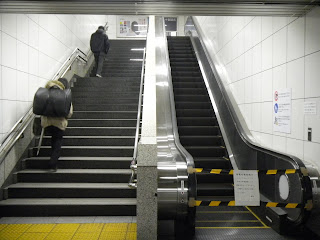
Electricity cuts are real and clearly evident. Most escalators in train stations are switched off except for the deeper lines like Oedo Line. Elevators still work. Good workout for quads, hamstrings and glutes I say.

Alternate street lights are meticulously
switched off. Unnecessary lighting in shops and public ares are minimised.


I felt that the wait between trains was longer than usual. Train schedules have been revised.
But I must congratulate the service. They were up and running at 90% less than 24 hours after the earthquake. I know because my son managed to get home the next morning, albeit via a less direct route.

The human spirit is strong.
It has to be for the sake of the children. . .
. . . and love.

Subscribe to:
Posts (Atom)


